Smile Simulation vs Traditional Dental Photography: Which Wins on Case Acceptance?
Smile simulation and traditional dental photography solve different problems. Here is how each performs on case acceptance, and how to use both together.
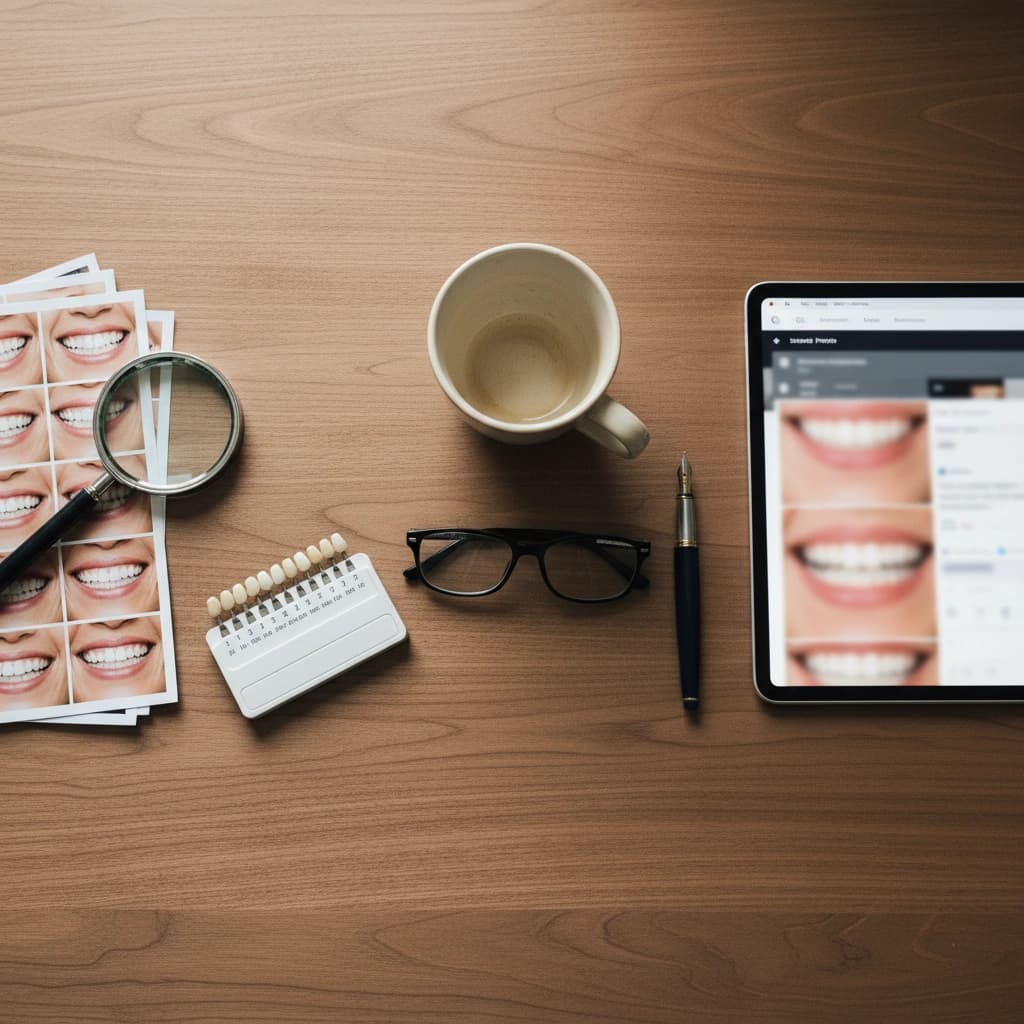
Almost every cosmetic dental practice has invested in some form of patient visualization. The two main camps are traditional dental photography, the before-and-after library you have been building since residency, and AI smile simulation, the newer category that generates a personalized preview of the patient's own smile in under a minute.
The question is not which one is better. They solve different problems. The question is when each one wins, where each one falls short, and how the best practices use both.
This is an honest comparison, written for cosmetic dentists who are deciding how to structure their consultation workflow.
What Traditional Dental Photography Does Well
Traditional photography has been the backbone of cosmetic case presentation for decades, and there are good reasons for that. A well-built photo library is one of the most valuable clinical and marketing assets a practice owns.
It documents your actual work. Every case in your photo library is real, finished, and verified. There is no question about whether the result is achievable, because you achieved it. That credibility is impossible to fake and impossible to replicate.
It demonstrates range. A patient considering veneers can see ten different cases, from conservative to dramatic, and start to develop a sense of what they want. Photography gives the patient a vocabulary for talking about their own preferences. They can point to the case and say "more like this one, less like that one."
It provides marketing material. The same photos that close cases in the consult room also fuel your website, your Instagram, your Google Business profile. A strong photo library compounds value across channels.
And it is permanent. Once you take a clinical-grade before-and-after series, it is yours forever. The investment in time and equipment pays out for years.
Where Traditional Photography Falls Short
The limitation of traditional photography is not the quality of the images. It is the gap between the patient looking at someone else's smile and the patient picturing their own.
Patients understand intellectually that the photos in your binder are real outcomes for real people. But "this is what someone else achieved" is a different mental experience from "this is what I will look like." The first triggers admiration. The second triggers commitment.
Patients with unusual starting points struggle the most with this gap. Someone with mild crowding, slight shade variation, and one cracked incisor cannot easily map themselves onto a stock case of someone with extensive worn dentition. They look at the photos, find none that match their starting point, and conclude that their case is too unusual to predict.
Photo libraries also have a representation problem. The cases in most practice libraries skew toward dramatic transformations because those are the most striking and the most often consented for marketing use. Patients with smaller or subtler cases often cannot find their archetype in the library.
What AI Smile Simulation Does Well
The unique advantage of AI smile simulation is precisely the gap that traditional photography cannot close: the patient sees their own face with the planned outcome.
Modern simulation tools take a smiling photo of the patient and render a new version of the smile based on the proposed treatment. Veneers, whitening, alignment, gum contouring. The patient looks at themselves, with the new smile, before they make a decision.
The case acceptance lift is consistent across practices that have adopted the tools. Numbers vary, but lifts in the 30 to 50 percent range over the practice's previous baseline are common. The mechanism is straightforward. When a patient can see the outcome, the decision shifts from imagination to evaluation. They are no longer asking "will I like the result." They are asking "do I like this result that I am looking at right now."
Simulation also handles the unusual cases that traditional photography struggles with. A patient with a specific combination of crowding, shade, and shape can see their specific combination, transformed. The simulation does not require finding a stock case that matches their starting point, because their starting point is the input.
Speed matters too. A simulation generated during the consult, while the patient is still in the chair, is exponentially more powerful than one delivered as a follow-up email. The decision moment is the consult moment.
Where AI Smile Simulation Falls Short
Simulation tools have legitimate weaknesses, and pretending otherwise hurts your evaluation.
They do not document real outcomes. A simulation is a prediction, not a record. It can never substitute for a verified case in your portfolio. Marketing materials, treatment planning records, peer review, malpractice defense, and continuing education all benefit from real before-and-after photography in ways that simulation cannot.
They can overpromise. The early generation of simulation tools sometimes generated results that flattered the patient's clinical situation in ways the doctor could not actually deliver. Modern tools have largely fixed this with conservative calibration, but the risk is still present and depends on the specific tool you choose. A simulation that over-delivers sets up a clinical disappointment.
They are decision tools, not planning tools. The simulation gets the patient to commit. Your case planning still happens with your standard workflow: photos, scans, mockups, lab communication. Treating the simulation as the case plan creates clinical risk.
They require a thoughtful patient conversation. A simulation without context can be confusing. The conversation needs to frame it as "this is approximately what we are aiming for" rather than "this is exactly what your smile will look like." Most patients accept this readily, but the framing matters.
Side-by-Side: Where Each Wins
| Use case | Traditional photography | AI smile simulation |
|---|---|---|
| Documenting completed cases | Best in class | Cannot do this |
| Helping a patient picture their specific outcome | Limited | Best in class |
| Marketing across web and social | Strong | Limited |
| Speed during consult | Slow if you have to find the right case | Under 60 seconds |
| Treatment planning records | Required | Supplementary only |
| Patients with unusual starting smiles | Often falls short | Handles well |
| Real-time conversation tool | Possible | Built for it |
| Cost over time | Equipment investment, then free | Subscription |
The honest answer is that neither tool wins outright. They cover different parts of the patient journey and the practice operations.
How the Best Practices Use Both
The strongest cosmetic practices in 2026 are not choosing between traditional photography and smile simulation. They are using both, with each tool deployed where it has unique advantage.
Traditional photography handles documentation, marketing, training, and clinical reference. Every completed case gets a full clinical photo series. Those photos populate the website, the social channels, the case library, and the treatment planning records.
Smile simulation handles the consultation conversation. When a new cosmetic consult happens, the team generates a simulation in the first 10 minutes of the visit, while the patient is still curious and present. The conversation pivots from "let me describe what we can do" to "here is what we can do, what do you think."
The patient leaves the consult having seen their own smile transformed and having signed up for treatment. The completed case becomes the next set of clinical photos that join the library. Both tools feed each other.
Practical Next Steps
If your practice already has a strong photo library and you are looking for the next acceptance unlock, AI smile simulation is the most direct lever you can pull. The tools have matured, the workflow is fast, and the data on case acceptance lift is consistent.
Smile PreVue runs in under 60 seconds on the iPad your team already uses, requires no special hardware, and includes a 3-day free trial with no credit card. Start your trial and run it on your next five cosmetic consults. Compare the conversations to your typical consults and let the data make the decision.
The combination of strong traditional photography and fast simulation is the current state of the art in cosmetic consultation. Practices that adopt both consistently outperform practices that adopt either one alone.
More from the Blog
Same-Day Case Acceptance: The Economics of Closing High-Ticket Cosmetic Cases in One Visit
Same-day case acceptance is the single biggest revenue lever in cosmetic dentistry. Here is the psychology, the math, and what makes a one-visit close possible.
Case AcceptanceTreatment Plan Presentation Framework: The 4-Phase Model for High-Ticket Cosmetic Cases
A 4-phase treatment plan presentation framework that lifts cosmetic case acceptance. The psychology, sequence, and missing piece behind a same-visit yes.
Case AcceptanceDental Case Acceptance Rate Benchmarks 2026: What Cosmetic Practices Actually Close
The honest dental case acceptance rate benchmark for 2026: real numbers by procedure, practice type, and case size, plus what separates the top quartile.