Virtual Smile Design vs AI Smile Simulation: Which One Closes More Cases?
Virtual smile design changed cosmetic dentistry. AI smile simulation is changing it again. Here's how the two compare for case acceptance, speed, and ROI.
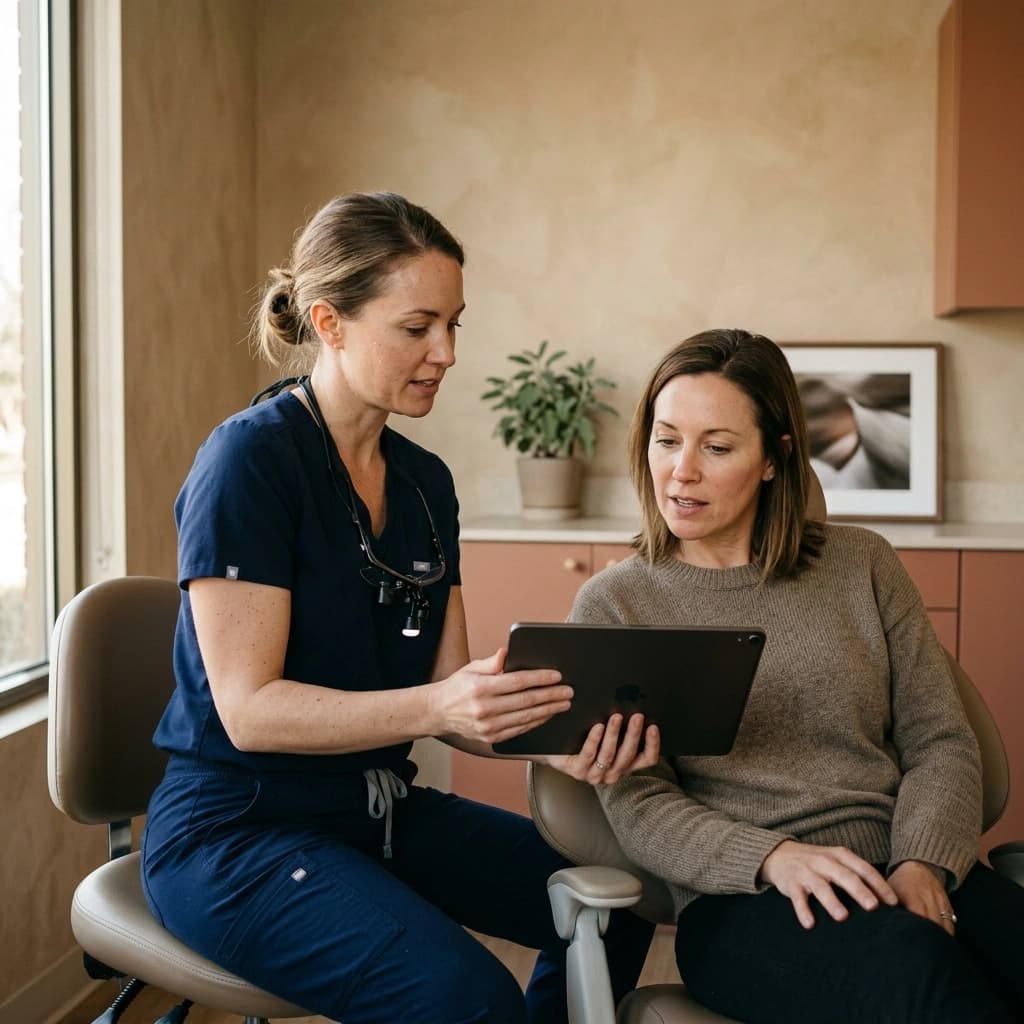
When a patient sits in your chair and asks about veneers, two things are almost always true. They want the result. And they cannot picture it.
That single gap, between desire and visualization, is where cosmetic cases get lost. Most patients will not commit five figures to a smile they can only imagine. They need to see it.
For the past decade, virtual smile design (VSD) was how the most case-driven practices closed that gap. In the last two years, AI smile simulation has rewritten the playbook. Both work. They work very differently.
Here is a practical breakdown of how the two approaches compare on speed, accuracy, cost, and the only metric that actually pays for your overhead: case acceptance.
What Is Virtual Smile Design
Virtual smile design is a digital workflow that turns photos, video, and intraoral scans into a customized smile mockup. The clinician (or a remote technician) uses design software to map proportions, midline, incisal edges, and tooth shapes. The output is a 2D or 3D visualization the patient can review.
VSD is not a single product. Digital Smile Design (DSD) is the most well known platform, with formal training programs and a global network of certified clinicians. Smilecloud, 3Shape TRIOS Smile Design, and a handful of others sit in the same category.
The strength of VSD is artistic precision. A trained operator can dial in micro details that reflect the patient's facial structure, lip dynamics, and personality. The result, when done well, is bespoke.
The cost of that strength is time. A polished VSD case can take 30 to 90 minutes of design work, sometimes more if it bounces back to a lab or remote tech for refinement. Most practices charge a separate consultation fee or absorb the cost into the treatment plan.
What Is AI Smile Simulation
AI smile simulation uses computer vision and generative models to produce a realistic smile preview from a single photo, usually in under two minutes. No scanner. No technician. No design course. The clinician (or office manager) takes a photo, picks a target shade and shape, and the software generates the result.
This category is newer. Smile PreVue, SmileFy, SmileSIM, and PreVu Dental all sit here, with different strengths around realism, shade accuracy, and workflow.
The strength of AI simulation is speed and accessibility. Any team member can run it during the same appointment. Patients see the result while they are still in the chair, while their interest is still high.
The trade off is granularity. AI simulation does not replace a full lab driven mockup for complex full mouth rehabilitation. It is built for the 80 percent of cosmetic cases (whitening, bonding, veneers, alignment) where a fast, photorealistic preview is enough to move the patient from "maybe" to "yes."
Side by Side: VSD vs AI Smile Simulation
| Factor | Virtual Smile Design | AI Smile Simulation |
|---|---|---|
| Time per case | 30 to 90 minutes | Under 2 minutes |
| Hardware required | Often scanner or DSLR setup | iPad or phone |
| Operator skill | Trained clinician or technician | Any team member |
| Cost per case | $50 to $200 (in-house or outsourced) | Included in monthly subscription |
| Best for | Full-mouth rehab, complex cases | Veneers, bonding, whitening, alignment |
| Patient sees result | Days later, often after a follow-up | Same visit, before they leave |
The overlap is real. A practice can absolutely use both, leaning on AI simulation for first consultations and reserving VSD for the cases that justify it.
The question for most practice owners is not "which one is better" in the abstract. It is "which one drives the case acceptance rate I need to actually grow."
The Case Acceptance Data
Industry estimates put the average cosmetic case acceptance rate between 30 and 45 percent. That is roughly half of patients who hear a treatment plan and walk away without committing.
Practices using visual previewing tools consistently report acceptance rates 20 to 40 percent higher than that baseline. The size of the lift depends on the workflow.
Here is what the pattern looks like in practice:
- Practices using only verbal consultations and stock before/after photos: 30 to 40 percent acceptance
- Practices using virtual smile design with delayed delivery: 45 to 55 percent acceptance
- Practices using AI smile simulation chairside: 55 to 70 percent acceptance
The big jump is not between VSD and AI simulation. It is between "patient sees nothing personalized" and "patient sees their own face." The bigger lift from AI simulation comes from one specific factor: timing.
Patients commit when interest is highest. That window starts when they ask about cosmetic options and closes the moment they walk out of the operatory. VSD often misses that window. AI simulation does not.
When Virtual Smile Design Still Makes Sense
This is not a piece arguing that VSD is dead. It is not.
VSD remains the right tool for:
- Full mouth rehabilitations where occlusion and bite need to be designed alongside aesthetics
- Cases that involve a lab partner who will fabricate from the digital design
- Patients who specifically want a highly customized, multi revision design process
- Practices that have already invested in scanners and have a trained design team
- Continuing education and clinical research where precision matters more than speed
If a practice already runs a strong VSD workflow with a trained team, the right move is usually to layer AI simulation on top, not replace it. Use AI simulation to convert the first conversation. Move the patient into VSD once they have committed.
When AI Smile Simulation Wins
For most general and cosmetic practices, AI simulation is the higher leverage tool. Here is when it is the clear winner:
- The practice is growing and needs more closed cases without adding clinical hours
- Most cosmetic cases are veneers, bonding, whitening, or aligners (not full rehab)
- The team is small and cannot dedicate a person to design work
- The practice owner wants every consultation to end with a same day decision
- The goal is volume across a patient base, not depth on a few showcase cases
The economics also tilt heavily toward AI simulation for high volume practices. A monthly subscription replaces per case design fees, which adds up fast across a practice doing 10 or more cosmetic consults a week.
The Patient Side of the Decision
There is one more factor that does not show up in feature comparisons. Patient psychology.
Patients are not asking for a CAD level rendering of their incisor proportions. They are asking, "Will I still look like myself with a better smile?" That question is emotional, not clinical.
A photorealistic preview that lands in 90 seconds answers that question while the emotion is still alive. A polished VSD that arrives by email three days later answers it after the patient has already started talking themselves out of treatment.
The best workflows treat the simulation like a closing tool, not a clinical document. The patient sees their face. They see the result. They feel something. Then the treatment plan goes from a number on a page to a thing they actively want.
What Practice Owners Should Actually Do
If a practice is closing fewer than half of its cosmetic consults, the highest leverage move is not better marketing or a bigger consultation room. It is closing the visualization gap.
Here is a simple decision path:
- If the practice has no smile preview tool today, start with AI simulation. It is fastest to deploy, requires no hardware, and the lift on case acceptance shows up in weeks.
- If the practice already runs VSD, layer AI simulation on the front end of the funnel. Use it during first consults to capture interest. Move VSD to post commitment design.
- If the practice is full rehab focused, lead with VSD and use AI simulation for the simpler cases that walk in alongside the big ones.
The wrong move is to keep doing verbal only consultations because "we already show patients photos of other cases." Other patients are not the patient in your chair. Stock photos do not close cases. Personalized previews do.
A Faster Way to Test This
Smile PreVue was built to fit into the gap above. It runs on the iPad already at the front desk. Setup takes about 10 minutes. Any team member can run it. There are 20 plus VITA shades and a library of smile shapes, and the output is a photorealistic preview the patient can hold in their hand before they leave the operatory.
The product is HIPAA compliant. There is no hardware to buy. Pricing starts at $149 a month, which is less than the design fee on a single VSD case.
Cosmetic dentistry is a confidence business on both sides of the chair. The clinicians who win the most cases are the ones who help the patient see themselves in the result.
If a practice wants to test the case acceptance lift before committing, Smile PreVue offers a 3-day free trial with full access. Run it on the next five cosmetic consults. The data will speak for itself.
More from the Blog
Same-Day Case Acceptance: The Economics of Closing High-Ticket Cosmetic Cases in One Visit
Same-day case acceptance is the single biggest revenue lever in cosmetic dentistry. Here is the psychology, the math, and what makes a one-visit close possible.
Case AcceptanceTreatment Plan Presentation Framework: The 4-Phase Model for High-Ticket Cosmetic Cases
A 4-phase treatment plan presentation framework that lifts cosmetic case acceptance. The psychology, sequence, and missing piece behind a same-visit yes.
Case AcceptanceDental Case Acceptance Rate Benchmarks 2026: What Cosmetic Practices Actually Close
The honest dental case acceptance rate benchmark for 2026: real numbers by procedure, practice type, and case size, plus what separates the top quartile.